
The Art of Heavy Rain (Part 4)

Player Choices Bear Consequence

There are multiple ways a scene can play out depending on the player’s past choices and those specifically made in that scene.
storytelling, branching structure, dramatic tension, the hero’s journey (heroic quest)
Players can get answers through dialogue choices and explore observations (and objectives) through a character’s thoughts.
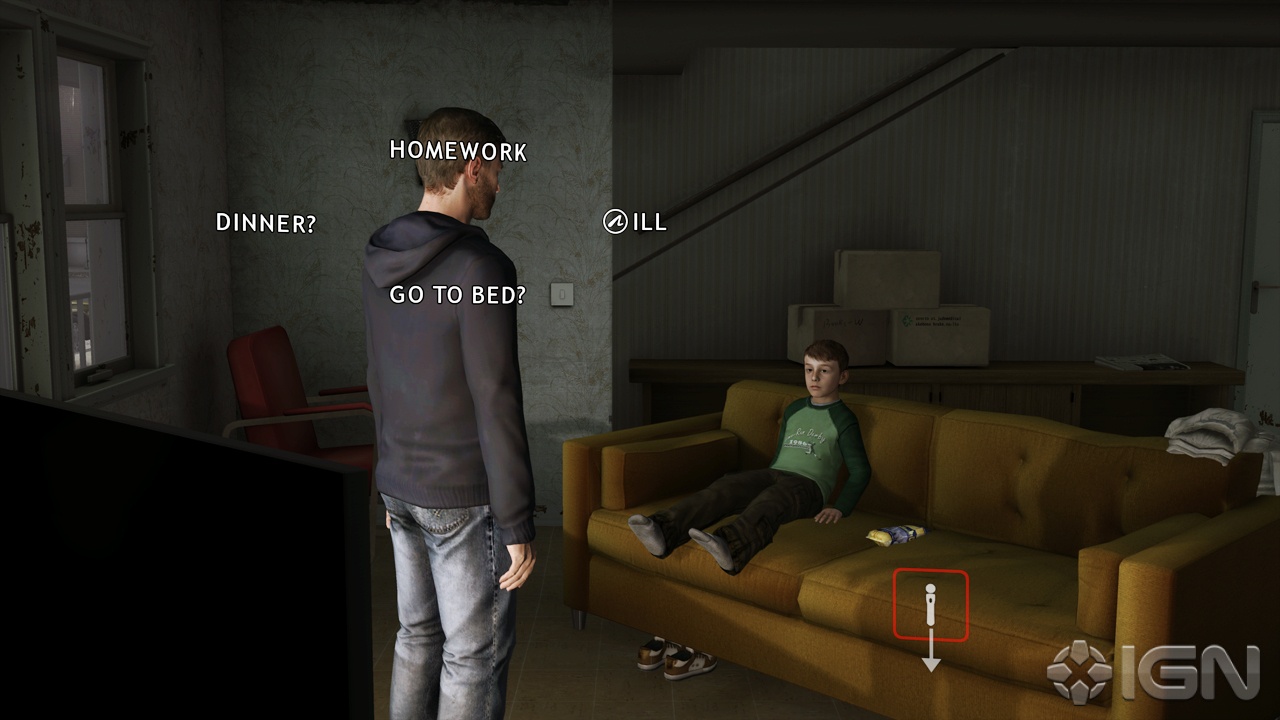
There is direct player control — with no specific run action. Most of the time, players won’t run indoors. Running is automatic during gameplay, to fit the emotional direction of the scene.


Win or Lose
There is no way to “lose” the game per se; only unfavorable events unfold, (i.e. characters die) or the player’s search is impeded (evidence is lost, players never meet important characters or situations to gather evidence.)
There are many scenes where the main characters can die in different ways at several points in the game; the game continues, but circumstances are heavily affected.


For example, those decisions have an effect on game’s unique combination of ending epilogues depending on the player’s choices carried out— rendering his experience and the denouement of his story, unique.


Environment
David Cage wanted the atmosphere of noir detective movies — dark, cold and disturbing  —  but also mysterious and fascinating.
Heavy Rain takes place in the urban, rundown districts of Philadelphia; this is evident as all of the victims’ coming from underprivileged backgrounds are from this area.
The developers took a trip to Philly to capture photo references and to get a feel for the area. This is to effectively convey the background mood of Heavy Rain. There were concepts to set the design for over 90 environmental scenes that made it in-game.
This set the tone for the true atmosphere of the game evoked in the opening —  the everyday scenes, to the characters in the foreground and the omnipresent rain.


Action Sequences
The action sequences in the Heavy Rain were designed to be as realistic as possible. The writers didn’t want the characters to be supermen well-versed in the martial arts.
Ethan is a family man with no training in the martial arts. Madison while good with movement, is not a hand-to-hand fighter. Jayden while he had some formal FBI training, is not too good fighting on the ground. Shelby however learned to fight in the streets and is a man of great brute force.


The action sequences were formulated by a stunt coordinator for film from a document describing the action sequences; then the stunt men would go into the mocap room to elaborate the final actions.

Comments

Popular posts from this blog

Review of the Alienware Graphics Amplifier

Laptop VS Desktop? Have both. What is a "graphics amplifier"? In essence an external GPU you can plug right into your system. Many companies have tried to release these onto the market, but sadly many haven't gotten past announcement phase. Users either resort to painstakingly building custom external graphics cards with components purchased all over the web or simply tossing aside their laptop and building a $10000 gaming PC for their graphics power needs. Both are acceptable, but Alienware and Razor (or any other company to announce one aain) give you another option: a mini-tower outfitted with a build-in PSU and cooling fan for your graphics power needs. Easier and More Flexible Wouldn't it be great to bring your laptop to work, coming back to your home office 2 hours later and gaming away as if it were that $10000 desktop? What a versatile workstation! No stray red, black and yellow cables sticking out of a shoebox or melted G...

Creating Action Scenes for Concept Art

Creating Action Scenes Concept Art Tutorial  After wrapping up my first fanart series on NieR:Automata ( catch it right here ), I would like to start a new walk-through series right here, on how I create action scenes for entertainment art. So, let's jump into it! Step 1: Reference and Thumbnails To start building a reference board, I use a free app called PureRef; it allows you to take any reference images that you like, and lay them out in an organized collage.  One thing to keep in mind when creating thumbnails, is it’s best to get as  many  ideas as you can down on paper. Don't be intimidated by that! There are no wrong ideas and it doesn't matter if it looks rudimentary at this stage.  When creating thumbnail sketches, think of what you want to see as the main focus of the scene; so, in this case, I want to have the main character 2B slashing a large machine – something inspired by an in-game screenshot. Now, with a rough sketch of b...

Time Manipulation in Game Design

Time Manipulation in Games Introduction The gameplay mechanic that I wish I had come up with first, is Time Manipulation. This is includes the concept of time dilation and the reversal of time in games. Implementing the Manipulation of Time Time manipulation is a robust mechanic. It involves non-exploitable time manipulation, with the goal of being fast and smooth, while not computationally-taxing on memory or hardware resources. The best way to implement this mechanic can be seen in Braid - an indie platform and puzzle game, developed by Number None, Inc. In this game, the world state is recorded for every frame, where the data is stored and compressed. With the recorded frames, any changing entities are extracted and mixed into the final state, which can be manipulated or rewound by the player. The player’s position is recorded and other properties such as color and rotation are stored as an integer that can be reconstructed, along with time information taken fro...